Latrodectus
- 176
- Global rank
- 176
- Month rank
- 163
- Week rank
Latrodectus is a malicious loader that is used by threat actors to gain a foothold on compromised devices and deploy additional malware. It has been associated with the IcedID trojan and has been used by APT groups in targeted attacks. The malware can gather system information, launch executables, and detect sandbox environments. It uses encryption and obfuscation to evade detection and can establish persistence on the infected device.
- Loader
- Type
- Unknown
- Origin
- 1 August, 2023
- First seen
- 11 August, 2026
- Last seen
How to analyze Latrodectus with ANY.RUN
IOCs
IP addresses
- 2.16.204.145
- 48.209.138.189
- 48.209.138.168
- 172.64.154.167
- 48.192.1.64
- 2.16.204.135
- 40.126.32.133
- 23.52.181.141
- 172.211.123.250
- 162.159.36.2
- 74.178.240.51
- 74.178.76.128
- 88.221.92.192
- 48.192.1.65
- 88.221.169.205
- 48.209.6.48
- 40.126.32.68
- 2.16.241.218
- 2.16.241.201
- 172.211.123.248
Hashes
- ec29ce8537e112869dfccb8a57574ebd01eecd7ff5c9fff54fdc1b05ea8941b3
- 62a2cb5aa12f592f3994d8e7a6483ae549b10df8f7c8064a91e9ccb7a2d53bdb
- 77bf693b39878fdfe8dae97ae541b54ebe3179ea4a98225713908eb1f49a4158
- aec5270b320843870d28012bc62676b219d4e3e815e54081a89bdf6b8ffce3ba
- 6f4ece9eef5c4e518ad56a6f82d14e95f93e4e5d07b1cb8d22de8666d7ac3d7f
- 4256488766553496d02c7dc5868938e34f24028f9841a5021560781e6f5b8d6e
- 298999caaa697082b5fd80903b1966482f211c921ab1ff74bb239c0db3337022
- b9fa2d52a4ffabb438b56184131b893b04655b01f336066415d4fe839efe64e7
- a8d081072ddd97380e854b9b664eaddcfafe6c28ee51c435f6d6b99919f1a105
- 8b4e15762e934422367a0fe0085258f7e73a294546680e3801e335a64fbdddd5
- 75da533888189d13fc340d40637b9fc07a3f732e3fcf33ec300f4c7268790a62
- 907f2709d1d3c8fa26294938f4080bc477e62281c4c50a082c22db0195cda663
- 22ca9415e294d9c3ec3384b9d08cdaf5164af73b4e4c251559e09e529c843ea6
- 474d668707f1cb929fef1e3798b71b632e50675bd1a9dceaab90c9587f72f680
- 3d0361a85adfcd35d0de74135723a75b646965e775188f7dcdd35e3e42db788e
- 6028bd681dbf11a0a58dde8a0cd884115c04caa59d080ba51bde1b086ce0079d
- 9c70f766d3b84fc2bb298efa37cc9191f28bec336329cc11468cfadbc3b137f4
- 0f1bad70c7bd1e0a69562853ec529355462fcd0423263a3d39d6d0d70b780443
- b3ece279943b28c8d855ec86ac1ce53bdfb6a709240d653508764493a75f7518
- 4ecedb9c1f3dd0d0e3aeb86146561b3d7e58656cbdbed1a39b91737b52ec7f2c
Domains
- google.com
- th.bing.com
- www.bing.com
- settings-win.data.microsoft.com
- activation-v2.sls.microsoft.com
- 51.240.178.74.in-addr.arpa
- fe3cr.delivery.mp.microsoft.com
- slscr.update.microsoft.com
- client.wns.windows.com
- login.live.com
- go.microsoft.com
- 164.77.179.74.in-addr.arpa
- clients2.googleusercontent.com
- assets.constantcontact.com
- edge.microsoft.com
- copilot.microsoft.com
- acroipm2.adobe.com
- api.edgeoffer.microsoft.com
- 9868svhbb.cc.rs6.net
- ocsp.digicert.com
URLs
- https://www.bing.com/threshold/xls.aspx?t=5&dl=1&f=9&wsbc=1
- https://th.bing.com/th?id=odswg.1e1da29b-91ea-4d2e-ac12-df81dfa2c53d&w=124&h=154&c=1&rs=1&p=0
- https://th.bing.com/th?id=ocge.9nm5764dbppg_v9_main&w=86&h=86&c=1&rs=1&p=0
- https://th.bing.com/th?id=opn.pe_5693e5c6-19d1-4c8a-84cb-85248d6405f9&w=140&h=96&c=1&rs=1&p=0
- https://th.bing.com/th?id=opn.pe_d9408c8e-5724-46a9-b7f1-4bf910a26067&w=140&h=96&c=1&rs=1&p=0
- https://th.bing.com/th?id=osk.d9d02de7c418534587e5be687df727a5&w=140&h=96&c=1&rs=1&p=0
- https://th.bing.com/th?id=ocge.9plgt00f15xs_abtesting_835b67e1-8ab1-490d-a6ab-e8840fad9bde&w=86&h=86&c=1&rs=1&p=0
- https://th.bing.com/th?id=ocge.9pltx207s22g_v6_main&w=86&h=86&c=1&rs=1&p=0
- https://th.bing.com/th?id=opn.pe_1e13b6cc-0ab3-4dd6-acf7-218c8c2be53c&w=140&h=96&c=1&rs=1&p=0
- https://th.bing.com/th?id=osk.f5873d89f968cc2d480b0f930e95ae4f&w=140&h=96&c=1&rs=1&p=0
- https://th.bing.com/th?id=ocge.9p3610rr8qt5_v3_main&w=86&h=86&c=1&rs=1&p=0
- https://th.bing.com/th?id=ocge.9p9rpk71ggql_v3_main&w=86&h=86&c=1&rs=1&p=0
- https://th.bing.com/th?id=ocge.9njb654d39wx_v12_main&w=86&h=86&c=1&rs=1&p=0
- https://th.bing.com/th?id=opn.pe_489223ad-97fa-4373-ad93-7f8a6f97c634&w=140&h=96&c=1&rs=1&p=0
- https://th.bing.com/th?id=odswg.d59d4f41-177b-4727-bfd9-f4f300aa3662&w=124&h=154&c=1&rs=1&p=0
- https://th.bing.com/th?id=ocge.9nbckjw55fsv_v6_main&w=86&h=86&c=1&rs=1&p=0
- https://th.bing.com/th?id=opn.pe_73774666-380a-41c6-9f06-23e82f450df0&w=140&h=96&c=1&rs=1&p=0
- https://th.bing.com/th?id=osk.3ba19440475e4b7cfe01e20a1b08771e&w=140&h=96&c=1&rs=1&p=0
- https://th.bing.com/th?id=odswg.bc00fe98-00b2-46fc-96fe-f385f609e12f&w=124&h=154&c=1&rs=1&p=0
- https://th.bing.com/th?id=ocge.9n7hl5s06zk0_abtesting_d91bec27-6f2b-4b8c-b317-00677b8039c6&w=86&h=86&c=1&rs=1&p=0
Last seen at
- ec29ce8537e112869dfccb8a57574ebd01eecd7ff5c9fff54fdc1b05ea8941b3.exe
- ec29ce8537e112869dfccb8a57574ebd01eecd7ff5c9fff54fdc1b05ea8941b3.exe
- ec29ce8537e112869dfccb8a57574ebd01eecd7ff5c9fff54fdc1b05ea8941b3.zip
- 2705484648e840fd63cbf1e79821bc3372340a87e14e3f5a4ac1330a9582125f.zip
- esetnod.msi
- 0cfa0bdd1f21ae4d71ab3b0978339be3bd578b9c0c6bf3eeeffed4a0ca3dd697.exe
- 0cfa0bdd1f21ae4d71ab3b0978339be3bd578b9c0c6bf3eeeffed4a0ca3dd697.exe
- 0cfa0bdd1f21ae4d71ab3b0978339be3bd578b9c0c6bf3eeeffed4a0ca3dd697.exe
- sample.zip
- b78dbc66a99cdec46ca38ee09f7804edf082987e8fd832c612479bf5d8a46df0.msi.bin
What is Latrodectus malware?
Latrodectus is a type of malware known as a "loader," which is designed to download and install additional malicious software onto a compromised computer. It is believed to have been developed by the same individuals or group behind the IcedID trojan, a sophisticated and widespread banking malware.
Since 2023, Latrodectus has been extensively used by a variety of threat actors, including advanced persistent threat (APT) groups such as TA578 and TA577, which was previously observed delivering the Qbot malware, a banking trojan family.
Latrodectus is typically delivered as part of multi-stage attacks, which often begin with a phishing email containing a malicious JavaScript file attachment. However, it has also been known to be dropped by other malware, including the DanaBot trojan.
One of the key features that has allowed security researchers to link Latrodectus to the IcedID authors is the use of a similar command and control (C2) infrastructure. C2 servers are used by malware to communicate with their operators, receive instructions, and exfiltrate data.
Latrodectus malware technical details
The primary functionality of Latrodectus is to receive commands from the attackers and perform them.
Some of the key capabilities of Latrodectus include:
- Getting a list of filenames of files located on the desktop of the infected machine.
- Listing all the processes currently running on the device.
- Gathering and transmitting additional system information about the endpoint, such as the OS version and hardware specs.
- Launching of executable files to install malware or to perform other malicious actions.
- Detonating dynamic link library (DLL) files.
- Using Windows command prompt to execute commands.
A typical Latrodectus infection chain begins with a JavaScript file that is responsible for downloading a malicious .msi file, which then leads to the deployment of the final payload on the system.
The malware implements obfuscation techniques, such as encrypting strings, to make it more difficult for researchers to analyze. It communicates with its command and control (C2) server via HTTPS, with both requests and responses encrypted using RC4 and base64 encoding.
Furthermore, Latrodectus has a built-in sandbox detection mechanism that works by enumerating the number of active processes on the device and checking for the presence of a MAC address.
The malware can establish a scheduled task for persistence, ensuring that it remains active on the infected machine even after a reboot. It also verifies if the computer is already infected with Latrodectus and exits execution if the result is positive.
Latrodectus execution process
Let’s detonate a sample of the Latrodectus malware in the ANY.RUN sandbox to observe its execution chain.
The infiltration process of the Latrodectus malware involves a sequence of steps that ultimately lead to its successful operation on a target system.
Upon launching a JavaScript file, it automatically retrieves an installer MSI. This MSI file implants a Latrodectus Dynamic Link Library (DLL) onto the system, allowing the malware to maintain persistence even after the system is rebooted.
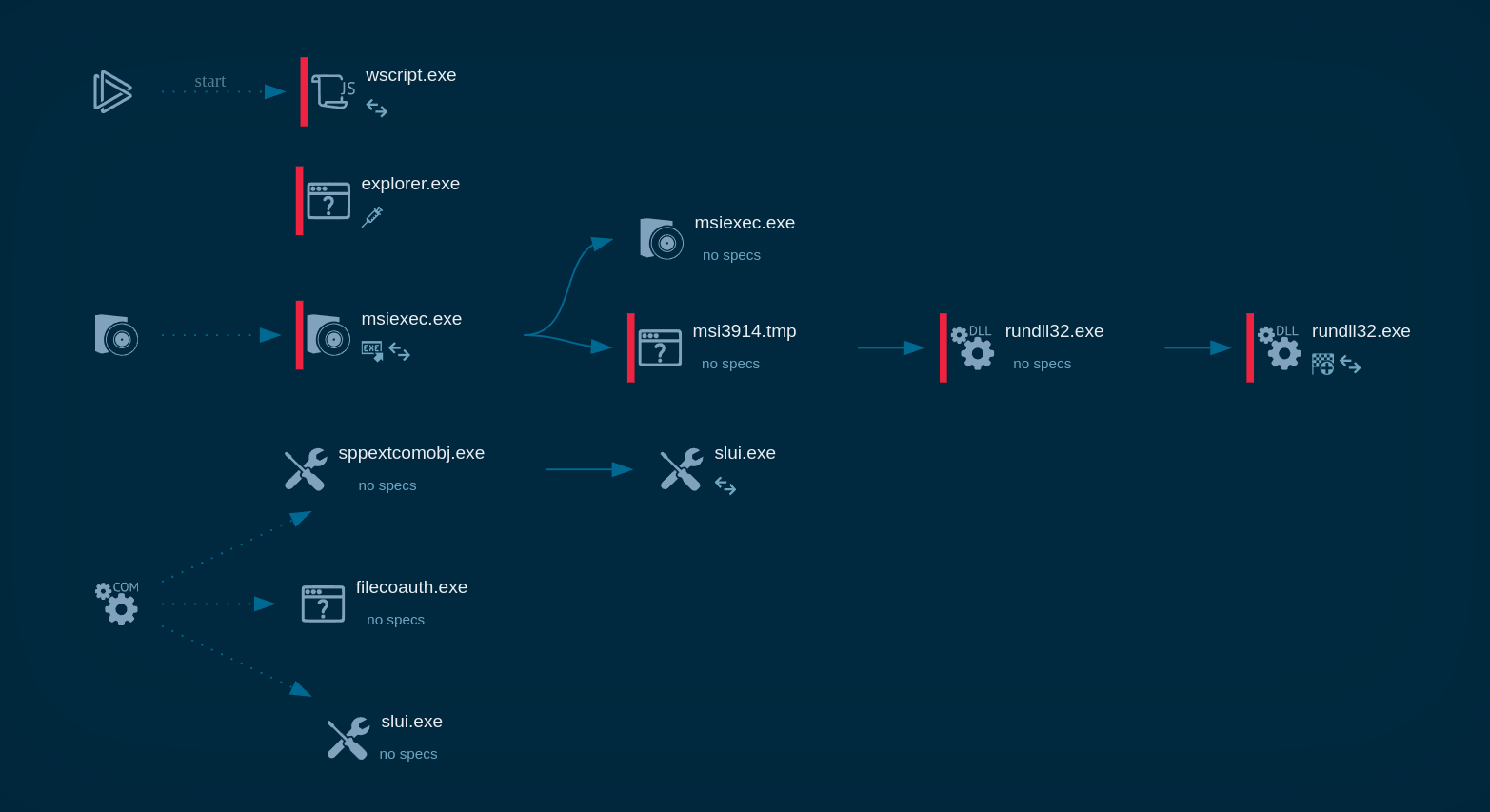
Once implanted, the Latrodectus malware establishes communication with its command-and-control (C2) server, providing remote access to the infected device for malicious actors.
Gathering threat intelligence on Latrodectus malware
To collect up-to-date intelligence on Latrodectus, use Threat Intelligence Lookup.
This service gives you access to a vast database filled with insights from millions of malware analysis sessions conducted in the ANY.RUN sandbox.
With over 40 customizable search parameters, including IPs, domains, file names, and process artifacts, you can efficiently gather relevant data on threats like Latrodectus.
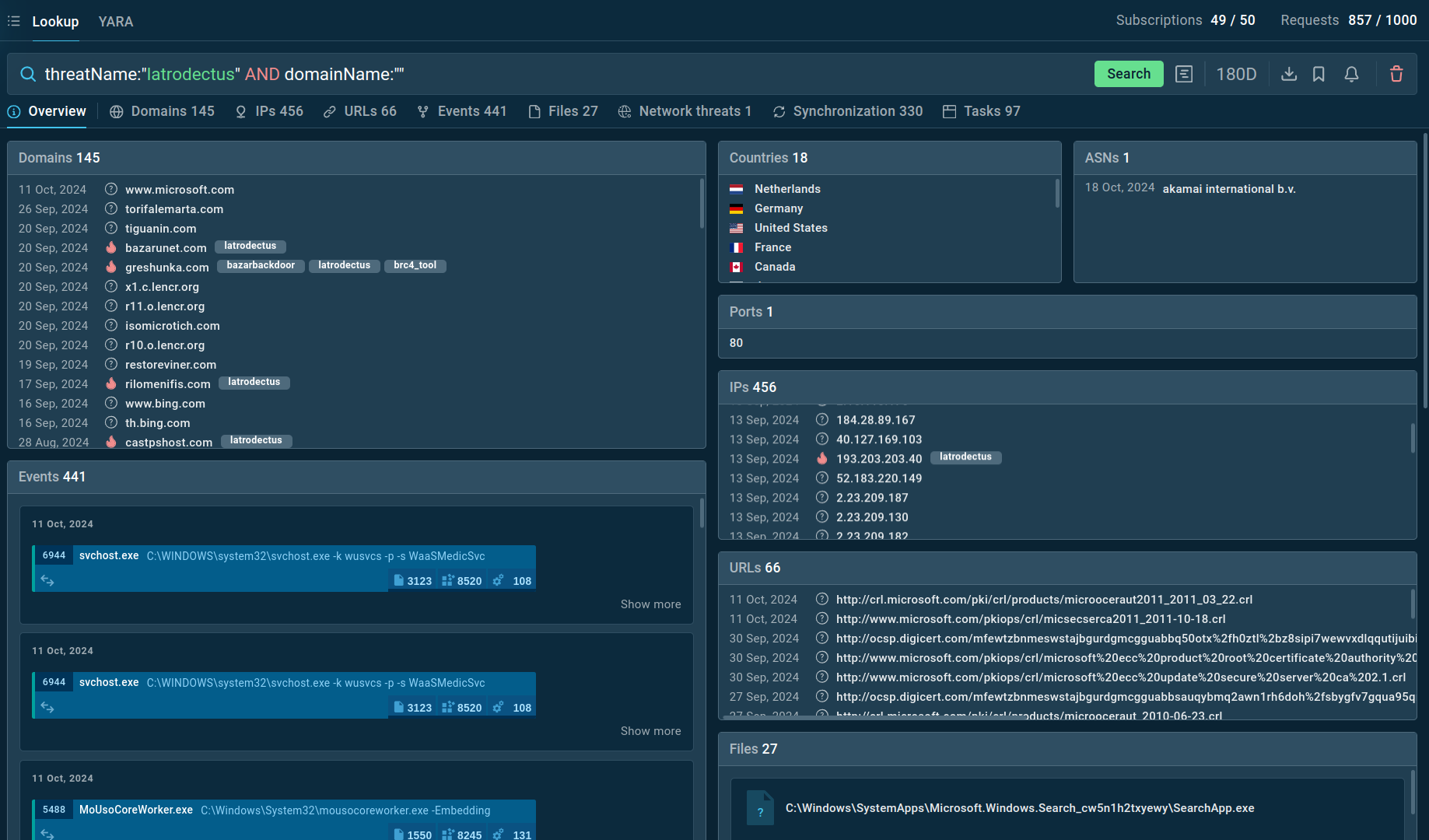
For example, you can search directly for the threat name or use related indicators like hash values or network connections. Submitting a query such as threatName:"latrodectus" AND domainName:"" will generate a list of other data extracted from Lumma samples along with sandbox sessions that you can explore in detail to gain comprehensive insights into this malware’s behavior.
Latrodectus malware distribution methods
Phishing emails are the most common attack vector by threat actors for distributing Latrodectus malware. These emails are typically designed to appear as if they have been sent from a legitimate organization or individual, to trick the recipient into opening an attached file or clicking on a malicious link.
In one particular campaign, the threat actor group TA578 was observed to be spreading Latrodectus as part of a scheme that involved accusing target companies of copyright infringement. The phishing emails in this campaign were designed to look like they were sent from a legitimate organization.
In another instance, a fake Azure page was used to initiate the infection chain.
Conclusion
Latrodectus is a noteworthy loader that presents a challenge due to its widespread use by professional cyber criminal groups. Its capacity to deploy payloads, along with its advanced obfuscation and evasion methods, as well as continuous development contribute to its potential to become an even more serious threat.
ANY.RUN is a cloud-based service that can be used to safely analyze suspicious files and URLs, including Latrodectus malware. It allows you to observe malware behavior and collect indicators of compromise in a secure environment. Using ANY.RUN can help you understand Latrodectus's tactics and improve your defenses against it.
Create your ANY.RUN account – it’s free!
Other malware & phishing threats
 TykitTykit is a sophisticated phishing-as-a-service (PhaaS) kit that emerged in May 2025, designed to steal Microsoft 365 corporate credentials through an innovative attack vector: malicious SVG files.
 Agent TeslaAgent Tesla is spyware that collects information about the actions of its victims by recording keystrokes and user interactions. It is falsely marketed as a legitimate software on the dedicated website where this malware is sold.
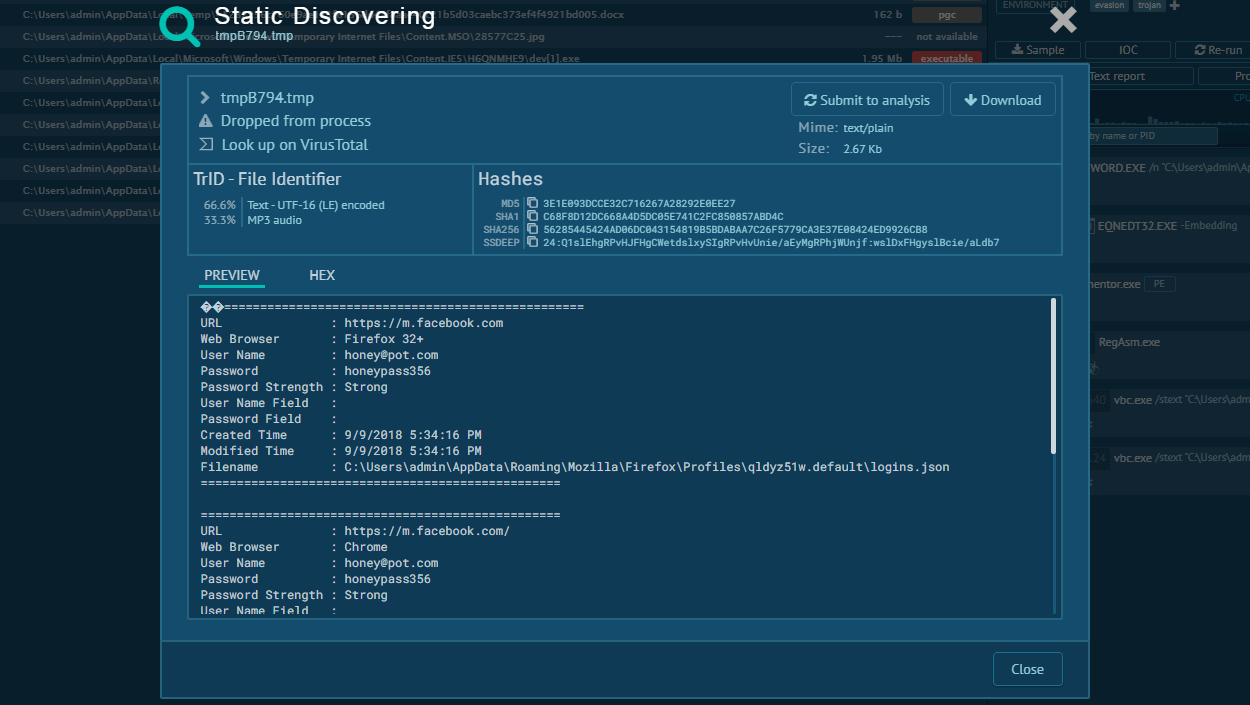 HawkeyeHawkeye often gets installed in a bundle with other malware. This is a Trojan and keylogger that is used to retrieve private information such as passwords and login credentials. This is an advanced malware that features strong anti-evasion functions.
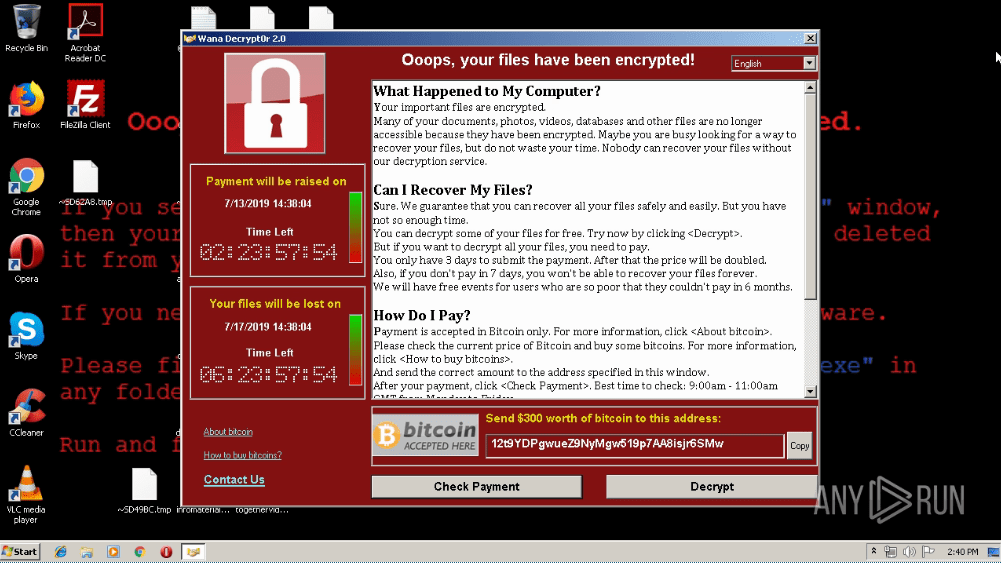 RansomwareRansomware is a type of malicious software that locks users out of their system or data using different methods to force them to pay a ransom. Most often, such programs encrypt files on an infected machine and demand a fee to be paid in exchange for the decryption key. Additionally, such programs can be used to steal sensitive information from the compromised computer and even conduct DDoS attacks against affected organizations to pressure them into paying.
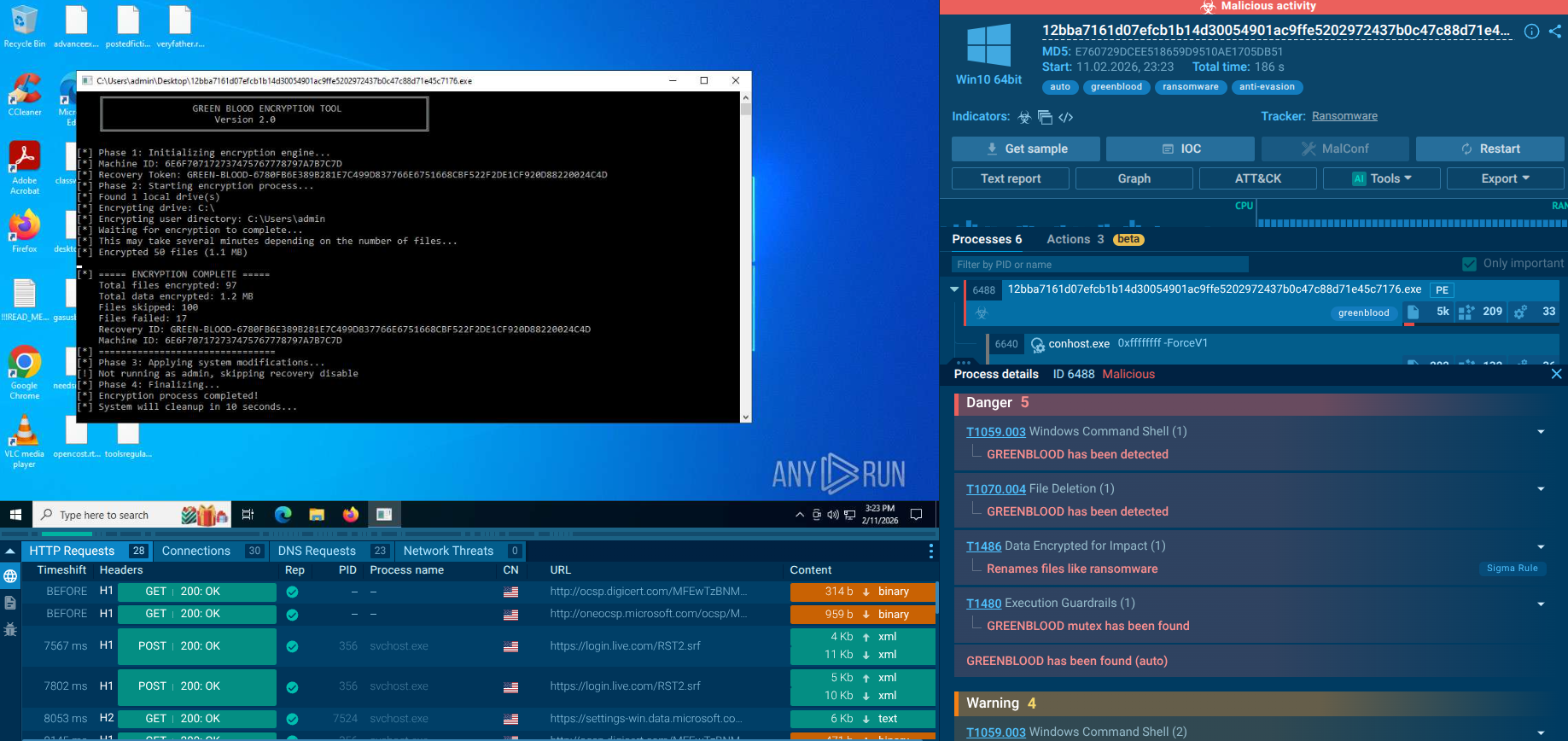 GREENBLOODGREENBLOOD is a Go-based ransomware that uses concurrent ChaCha8 encryption to lock entire Windows environments in under a minute while systematically destroying backups, disabling defenses, and threatening double extortion through a Tor-based data leak site.
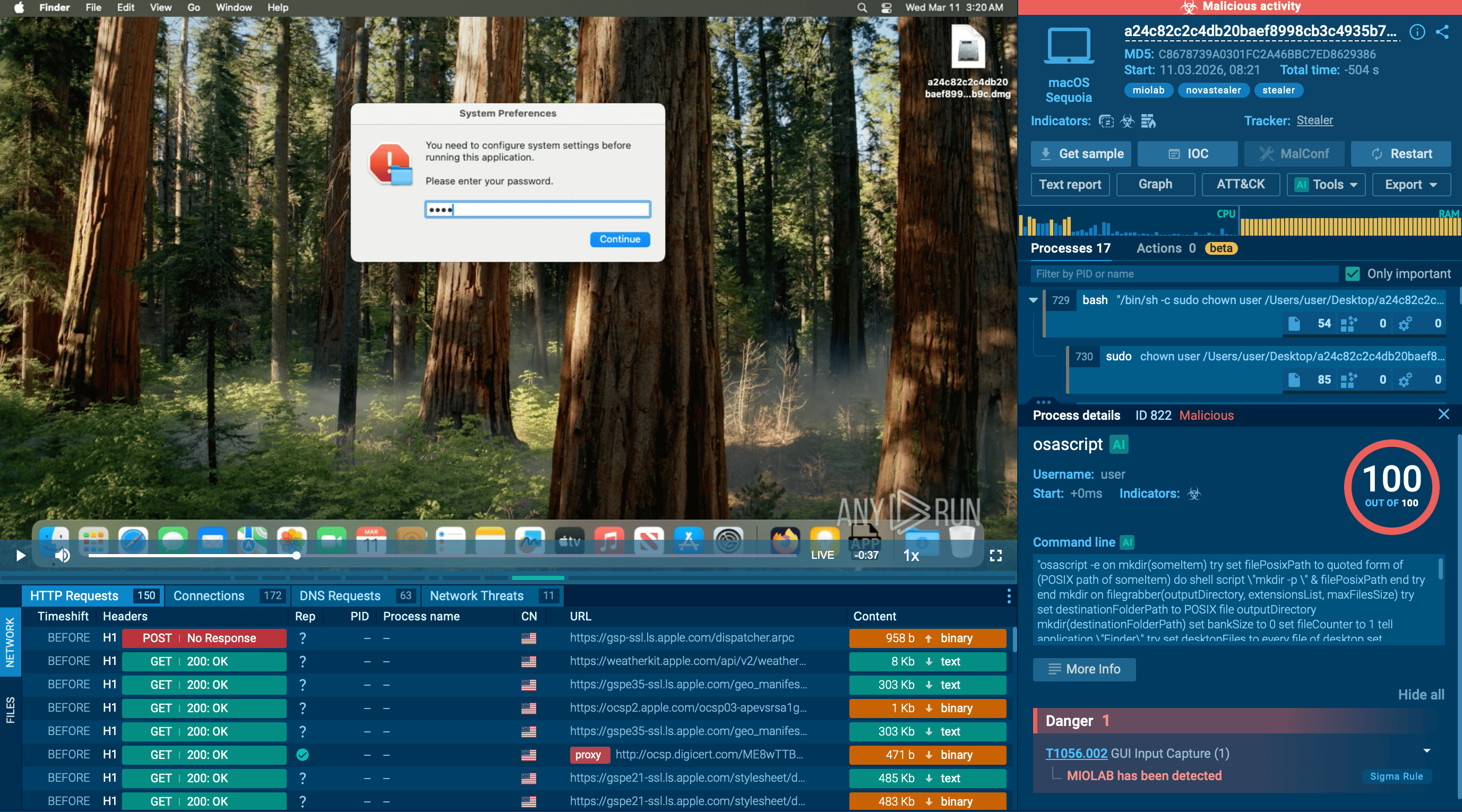 Miolab StealerMiolab Stealer is a macOS malware threat designed to steal user credentials and sensitive files without raising immediate suspicion. It relies on fake system prompts and legitimate built-in tools to make malicious actions look routine. Instead of causing obvious disruption, it quietly collects valuable data and prepares it for exfiltration from the device. By blending deception with trusted macOS behavior, it increases the chance that the attack will go unnoticed in its early stages. This makes early behavioral detection critical before the theft of credentials and files is complete.