Gafgyt
- 101
- Global rank
- 57
- Month rank
- 65
- Week rank
Gafgyt, also known as BASHLITE, is a botnet affecting Internet of Things (IoT) devices and Linux-based systems. The malware aims to compromise and gain control of these devices, often by exploiting weak or default passwords, as well as known vulnerabilities. Gafgyt has been around since 2014 and has evolved into multiple variants, each with its own set of features and capabilities, including the ability to launch distributed denial of service (DDoS) attacks.
- Botnet
- Type
- Unknown
- Origin
- 1 September, 2014
- First seen
- 15 October, 2026
- Last seen
How to analyze Gafgyt with ANY.RUN
IOCs
IP addresses
- 185.125.190.56
- 91.189.91.62
- 91.189.91.98
- 185.125.190.58
- 91.189.91.57
- 64.89.160.185
- 176.65.139.166
- 91.189.91.61
- 91.189.91.60
- 77.90.7.228
- 91.189.91.157
- 185.125.190.57
- 91.189.91.64
- 45.137.70.17
- 91.189.91.96
- 94.130.221.11
- 185.125.190.101
- 151.101.1.91
- 89.163.176.12
- 151.101.65.91
Hashes
- d810f1253ee4bee05ca96a70a9c293f2839fb00b2aa238861f7b89e3a66bd357
- 870664caab45d08097135ba3cc82b378055468cbc9a3ff34f4f53243842b7a06
- 4e387440e65927ae17d8503c58de3938c2228197a12a45f5b5830e2fb9fc2b9f
- 0630f475e13ca70066118e08dc47abf9694eaa6b4d9d49e16922ed0b65eb6075
- fda276fc876e6f1aa80c76f897f7f77c75fea987c1fbdb209e775b7f1a2e01d7
- 1323bf9b2f2057fdca3988ffd183ee97875f3600309c14f917ae0b013142cc80
- 1a8b88d6c445b28d59a63a45db2af489e527475b8910905c5ddcf9fe433a75ea
- dc2adaa551af3e6fa6a76ec4f9c9599e39da33705dc22fe186d52f4b3c57a074
- 3e95e873dedae3cbe5458444b3cca9270a7d8dfcc998eb79adc651a04c518413
- 80966dd91fb4f2b41cc4303f334e83bd9065266b99faaa58ef00357e5a5dd1b0
- 763bc9ee419953625fb1f5095eeb3e55bc7058b41658ab455be77985f3e0b4de
- 7bdb2edff669a7dc719ba30b25d350513b463a19ea0409721f6f83bdf41af795
- 9fc7e01538bfb833f15926ac3b4874b4da88c94c0db179d486203f55a2fa7c0d
- fdc4b322f78c2fe109cfa1a7476f2a1bd4146e23b607bbc0040830a24f072428
- ede4c9a228a124b0735b72fffe9121596c184b676bdc298dfe4ad5b77421cd12
- 4377e894b3e7956b74d467118164b7023e9b0f0f4c151e464d00991e30f924ac
- 54ca0fff0512beb2d9bcb0106ada98b3d319b64e0fc1a4128eee13b89521495e
- 5279f80f139fcf962ac44abc4b79b67d14807c8f5a6d9ec8e9e3f7023532961d
- af9e9282f709e6913c75c36dec0fcba391d04671f436fa51ed88424b7cedd7f7
- bd9ac14ea870f3659a3e99718e00aa118b69e736fa783fd196737aa80ae205eb
Domains
- connectivity-check.ubuntu.com
- ntp.ubuntu.com
- google.com
- 5.100.168.192.in-addr.arpa
- 6.100.168.192.in-addr.arpa
- 3.100.168.192.in-addr.arpa
- 8.100.168.192.in-addr.arpa
- gay.energy
- 9.100.168.192.in-addr.arpa
- 4.100.168.192.in-addr.arpa
- cdn.fwupd.org
- 2.debian.pool.ntp.org
- 11.100.168.192.in-addr.arpa
- 10.100.168.192.in-addr.arpa
- 7.100.168.192.in-addr.arpa
- www.bing.com
- settings-win.data.microsoft.com
- crl.microsoft.com
- slscr.update.microsoft.com
- edge.microsoft.com
URLs
- http://connectivity-check.ubuntu.com/
- http://crl.microsoft.com/pki/crl/products/microoceraut2011_2011_03_22.crl
- http://www.microsoft.com/pkiops/crl/microsoft%20secure%20server%20ca%202026.crl
- http://edge.microsoft.com/browsernetworktime/time/1/current?cup2key=2:uvssy7vkclsznfpgrham5lsrni0e8kkyaazebj-gw1m&cup2hreq=e3b0c44298fc1c149afbf4c8996fb92427ae41e4649b934ca495991b7852b855
- http://176.65.139.140/bins/i686
- https://edge.microsoft.com/serviceexperimentation/v3/?osname=win&channel=stable&osver=10.0.19045&devicefamily=desktop&installdate=1661339457&clientversion=133.0.3065.92&experimentationmode=2&scpguard=0&scpfull=0&scpver=0
- https://copilot.microsoft.com/c/api/user/eligibility
- https://config.edge.skype.com/config/v1/edge/133.0.3065.92?clientid=4489578223053569932&agents=edge%2cedgeconfig%2cedgeservices%2cedgefirstrun%2cedgefirstrunconfig&osname=win&client=edge&channel=stable&scpfre=0&osarch=x86_64&osver=10.0.19045&wu=1&devicefamily=desktop&uma=0&sessionid=72&mngd=0&installdate=1661339457&edu=0&soobedate=1504771245&bphint=2&fg=1&lbfgdate=1766137499&lafgdate=0
- https://edge.microsoft.com/extensionwebstorebase/v1/crx?os=win&arch=x64&os_arch=x86_64&nacl_arch=x86-64&prod=edgecrx&prodchannel=&prodversion=133.0.3065.92&lang=en-us&acceptformat=crx3,puff&x=id%3djmjflgjpcpepeafmmgdpfkogkghcpiha%26v%3d1.2.1%26installedby%3dother%26uc%26ping%3dr%253d279%2526e%253d1
- https://update.googleapis.com/service/update2/json?cup2key=14:hcs21xg-jkf887cnxifi02uo6pcdbreeviaoszhudmo&cup2hreq=008f724adbdc3c5f7a2c4fc5c1707739791edd4562f7b2c932b1f19b6c3a3151
- https://www.bing.com/api/shopping/v1/user/shoppingsettings?enabledservicefeaturesv2=edgeserverux.shopping.cashbackeumarkets,edgeserverux.shopping.msedgeshoppingcashbackdismisstimeout2s
- https://api.edgeoffer.microsoft.com/edgeoffer/pb/experiments?appid=edge-extensions&country=us
- https://edge.microsoft.com/abusiveadblocking/api/v1/blocklist
- https://clients2.googleusercontent.com/crx/blobs/abe5cl52ck7wwbndbvvaem8oys3yhboz1h4zjji-spceoodztoqtbav4glxcdddxfkjcfz5qxdftce2lflmfl4fmgxvilhkmrudcuedenzrbmgjjiqxwnwfy8qwxmtkglheaxlka5bx6yvrdaanj1smxvmii4akl_ln2/ghbmnnjooekpmoecnnnilnnbdlolhkhi_1_110_1_0.crx
- https://edge.microsoft.com/entityextractiontemplates/api/v1/assets/find-assets?name=arbitration_priority_list&version=24.*.*&channel=stable&key=d414dd4f9db345fa8003e32adc81b362
- https://edge.microsoft.com/entityextractiontemplates/api/v1/assets/find-assets?name=edge_hub_apps_manifest_gz&version=4.11.*&channel=stable&key=d414dd4f9db345fa8003e32adc81b362
- https://edge.microsoft.com/entityextractiontemplates/api/v1/assets/find-assets?name=domains_config_gz&version=3.*.*&channel=stable&key=d414dd4f9db345fa8003e32adc81b362
- https://config.edge.skype.com/config/v1/edge/133.0.3065.92?clientid=4489578223053569932&agents=edgeruntime%2cedgeruntimeconfig%2cedgedomainactions&osname=win&client=edge&channel=stable&scpfre=0&osarch=x86_64&osver=10.0.19045&wu=1&devicefamily=desktop&uma=0&sessionid=72&mngd=0&installdate=1661339457&edu=0&soobedate=1504771245&bphint=2&fg=1&lbfgdate=1790239346&lafgdate=0
- https://go.microsoft.com/fwlink/?linkid=2257403&clcid=0x409
- https://login.live.com/rst2.srf
Last seen at
What is Gafgyt malware?
Gafgyt, also known as BASHLITE, LizardStresser, and Torlus, is a malware family that targets Linux-based IoT devices such as routers and IP cameras. It is known for its botnet capabilities, which allow it to conduct DDoS attacks and perform other malicious activities.
Gafgyt has been active since at least 2014, when it was initially named Bashdoor. Over the years, it has been responsible for multiple high-profile DDoS attacks. For instance, in 2019, the botnet was used to disrupt the operations of Valve Source Engine and games like Fortnine by targeting their servers.
The prevalence of this malware can be attributed to the fact that its original code was exposed to the public in 2015. Since then, different threat actors have used it to build their own strains of the malware and employed them in numerous attacks.
Gafgyt execution process
We can study the behavior of Gafgyt on an infected system by analyzing its sample in ANY.RUN’s cloud malware sandbox.
We are going to use an .elf file sample, which is an executable format on Linux systems commonly used by attackers to distribute Gafgyt. View the analysis session by following this link.
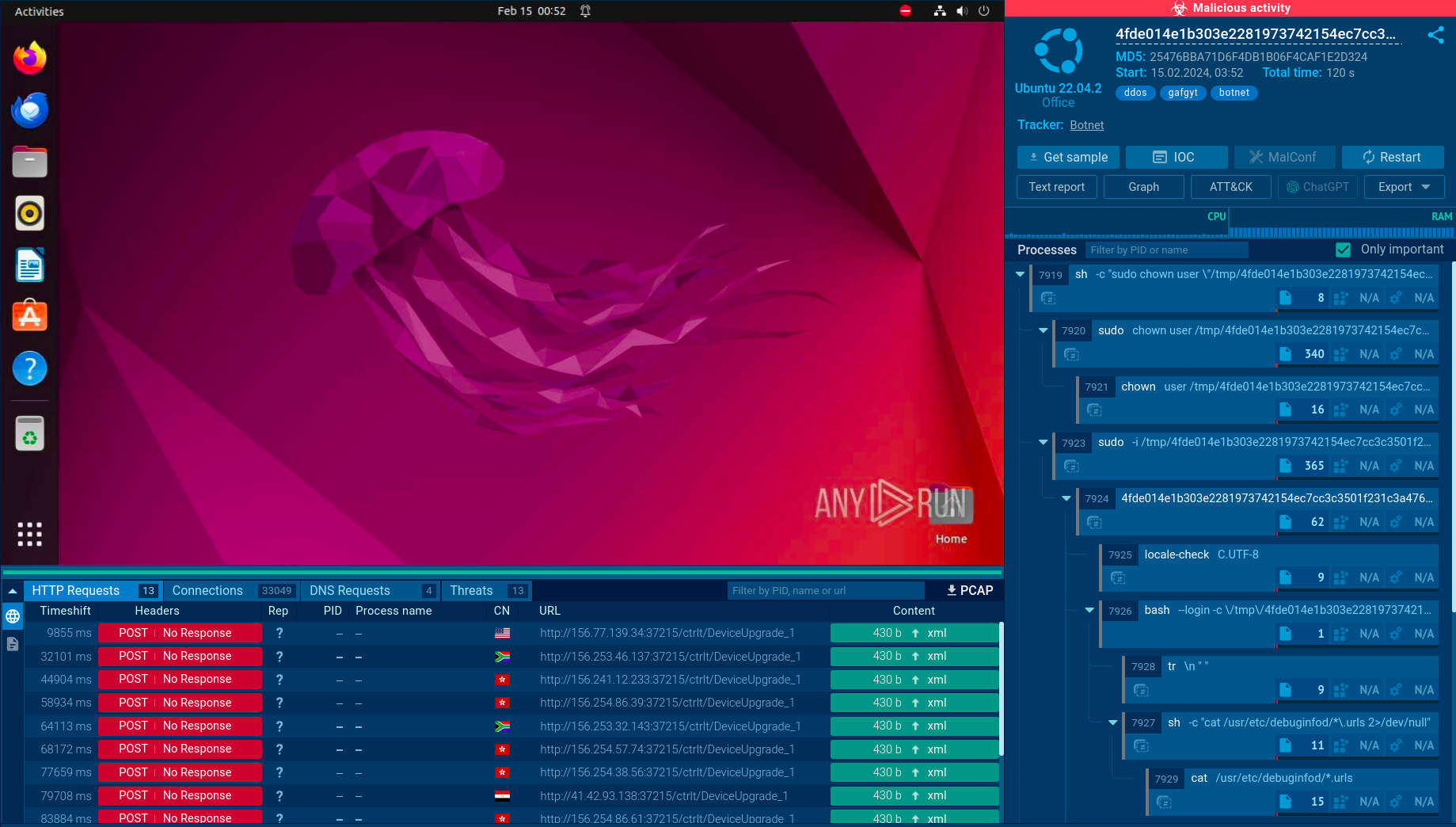
After launching the analysis, the service instantly detects Gafgyt and starts to record all of its malicious activities.
When looking at the Connections tab, we can see how the infected machine joins a botnet and participates in a DDoS attack. Specifically, the sandbox shows how the machine begins making thousands of connections.
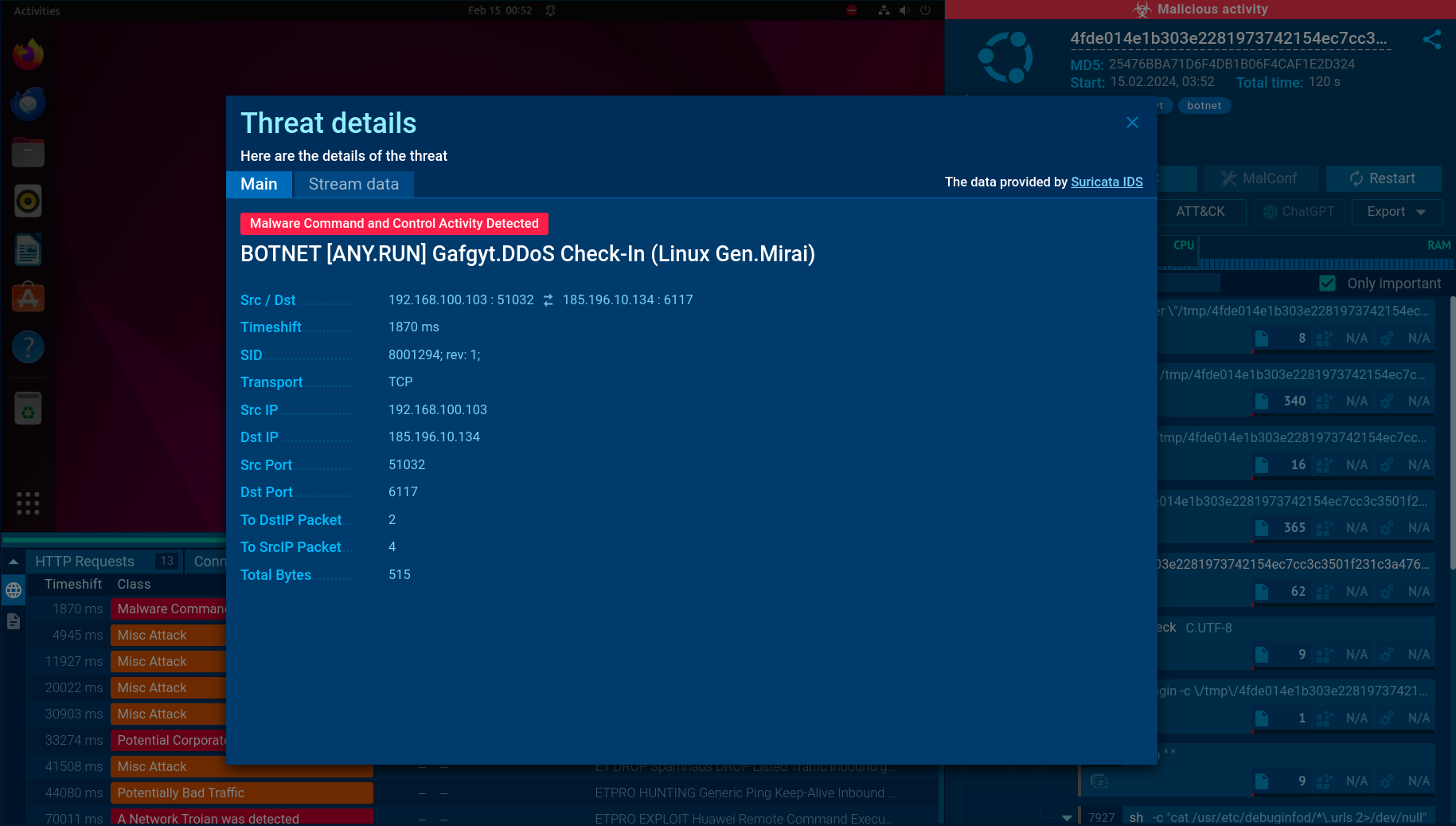
When exploring the Threats tab, we can observe the Suirata rules which were triggered during the analysis process. We can click on each one to access more details.
Gafgyt malware technical details
Gafgyt is written in C programming language. It uses a modular structure, which allows it to dynamically load and execute plugins. Interestingly, some of the versions of Gafgyt utilize code originally found in the Mirai malware, including TCP and HTTP flooding modules.
The primary way used by Gafgyt to hijack IoT devices is through brute forcing. The malware has a hard-coded list of default Telnet and SSH credentials which it employs in its attempts to penetrate devices.
Another method of infecting devices utilized by Gafgyt is through vulnerabilities. For instance, CVE-2017-18368 is one of the flaws exploited by the malware to target Zyxel routers. It is possible because of a lack of proper input validation in the Remote System Log forwarding function.
CVE-2023-1389 is another vulnerability abused by the most recent variants of Gafgyt. It is present on TP-Link Archer devices and once again involves the execution of an unauthorized malicious command that can be added to the country form in the web management interface.
After infecting the device, Gafgyt usually downloads a script from a pre-configured address and launches it. After collecting the device’s IP address and system information, it connects to its command-and-control server (C2).
Next, the C2 may send instructions to the malware which usually include engaging in different types of flooding attacks on specified targets.
The malware uses a combination of symmetric and asymmetric encryption for its communication.The malware's C2 servers are typically hosted on compromised devices.
Some versions of Gafgyt also have a persistence mechanism that allows it to survive device reboots.
Gafgyt malware distribution methods
Unlike botnet malware such as Socks5Systemz that spreads via loaders, Gafgyt is usually distributed through exploitation of security flaws in IoT devices. This can include devices with open Telnet or SSH ports, devices with default or weak credentials, and devices that have not been patched for known vulnerabilities.
It also has a self-propagation mechanism, which allows it to spread to other devices without any user interaction. This is typically done by scanning the internet for devices with open ports and attempting to gain access using default credentials.
The malware can also be distributed through malicious downloads. This can occur when a user downloads and executes a file from an untrusted source, such as a malicious website or email attachment.
How to analyze BASHLITE malware
Despite being decade-old, Gafgyt continues to be a considerable threat. It is particularly serious for organizations with Linux-based infrastructure. Protecting against a Gafgyt infection requires a combination of security measures, including strong unique passwords and timely patching.
To understand how Gafgyt and other malware operate, as well as to collect indicators of compromise, use ANY.RUN’s interactive sandbox.
The service is invaluable for malware analysts and SOC professionals, as it:
- Detects threats in files and links in under 40 seconds.
- Lets you interact with the samples and the system just like with a standard computer.
- Offers customizable Windows and Linux virtual machines. -Generates comprehensive threat reports. -Exposes all malicious network, registry, & files activity and processes.
With ANY.RUN, you can strengthen your security posture.
Create your ANY.RUN account – it’s free!
Other malware & phishing threats
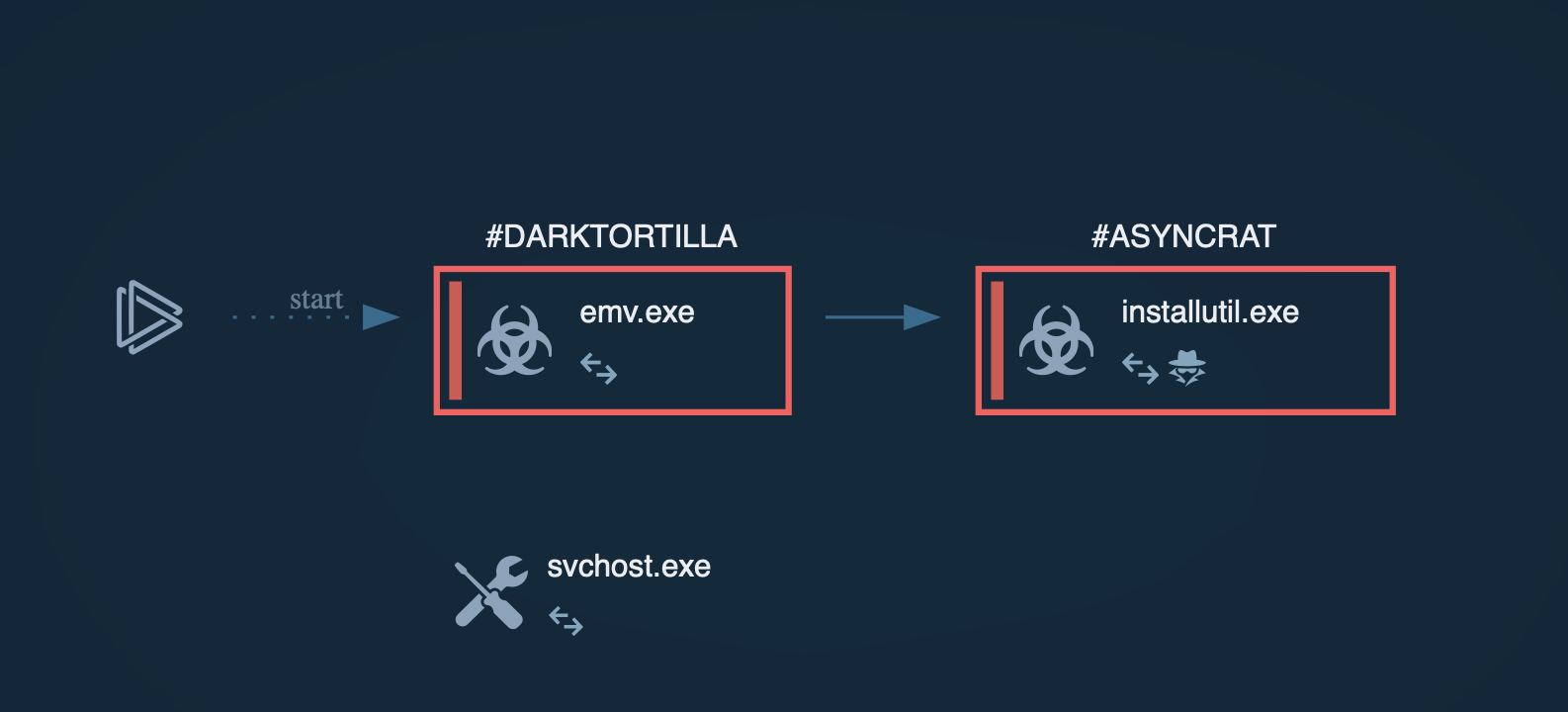 DarkTortillaDarkTortilla is a crypter used by attackers to spread harmful software. It can modify system files to stay hidden and active. DarkTortilla is a multi-stage crypter that relies on several components to operate. It is often distributed through phishing sites that look like real services.
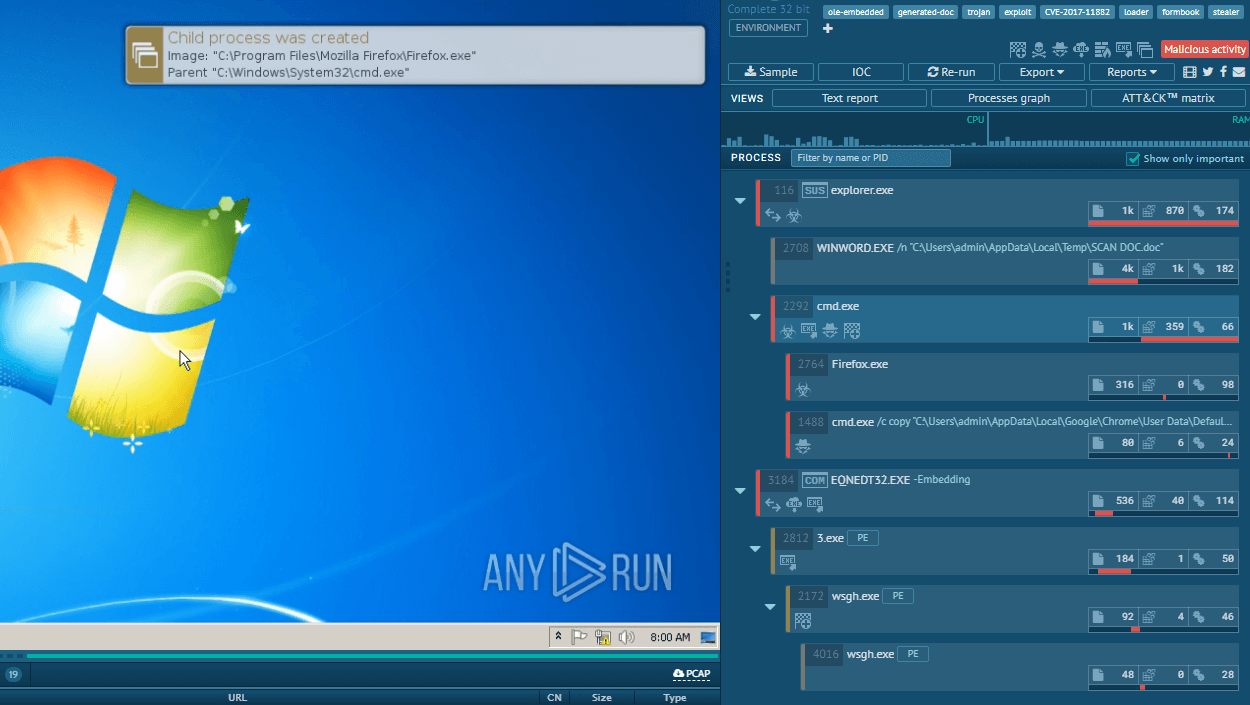 FormbookFormBook is a data stealer that is being distributed as a MaaS. FormBook differs from a lot of competing malware by its extreme ease of use that allows even the unexperienced
threat actors to use FormBook virus.
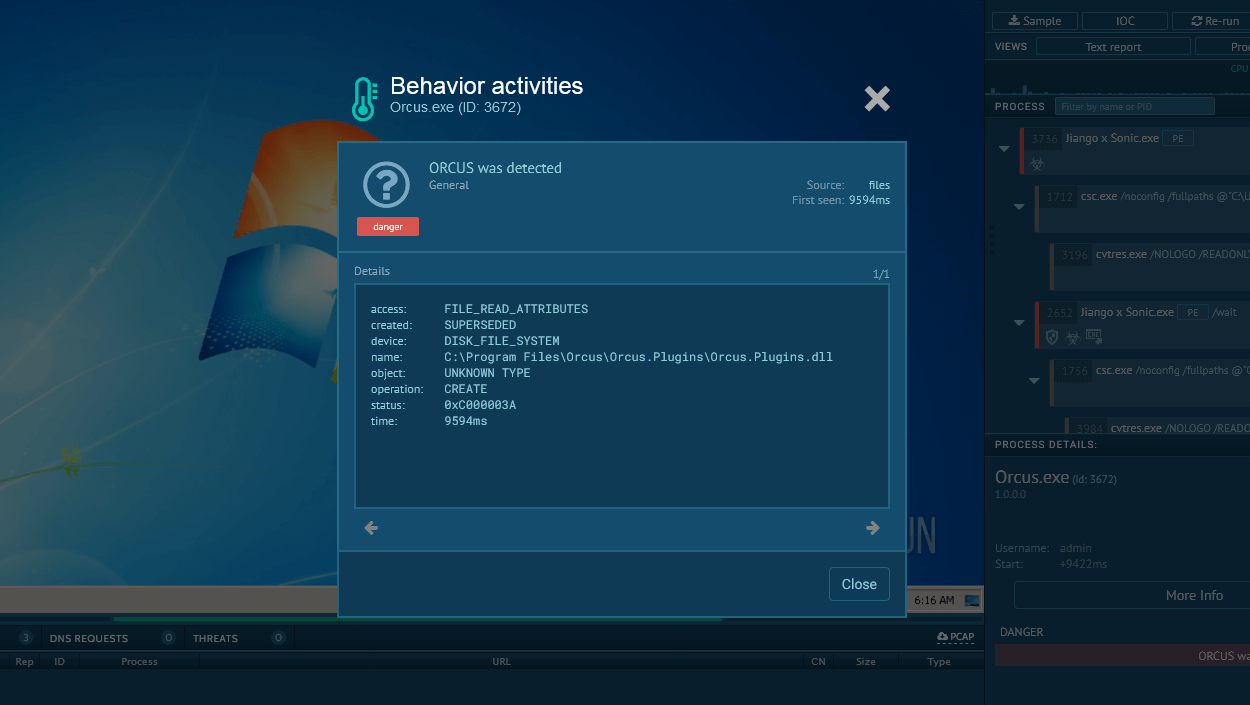 Orcus RATOrcus is a modular Remote Access Trojan with some unusual functions. This RAT enables attackers to create plugins using a custom development library and offers a robust core feature set that makes it one of the most dangerous malicious programs in its class.
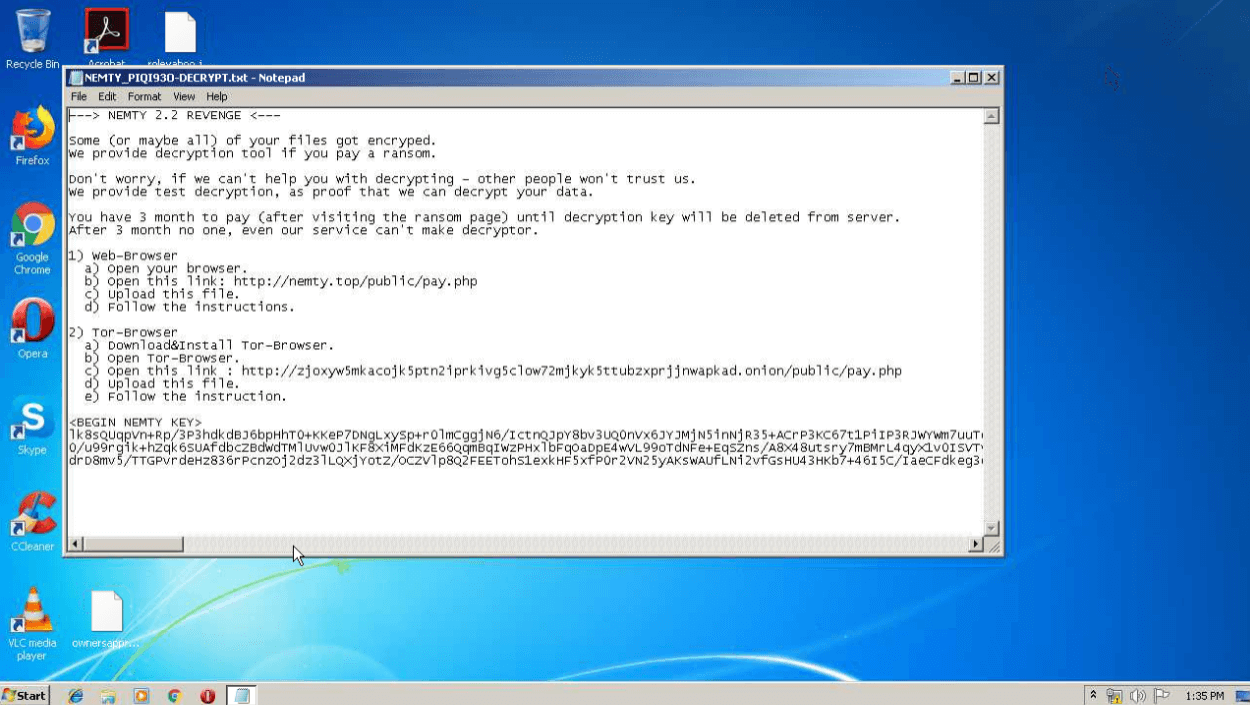 NemtyNemty is ransomware with an unusually complex encryption algorithm. This malware encrypts user files and demands money so that they can be unlocked again. It may be connected to other famous ransomware, but we don’t know for sure.
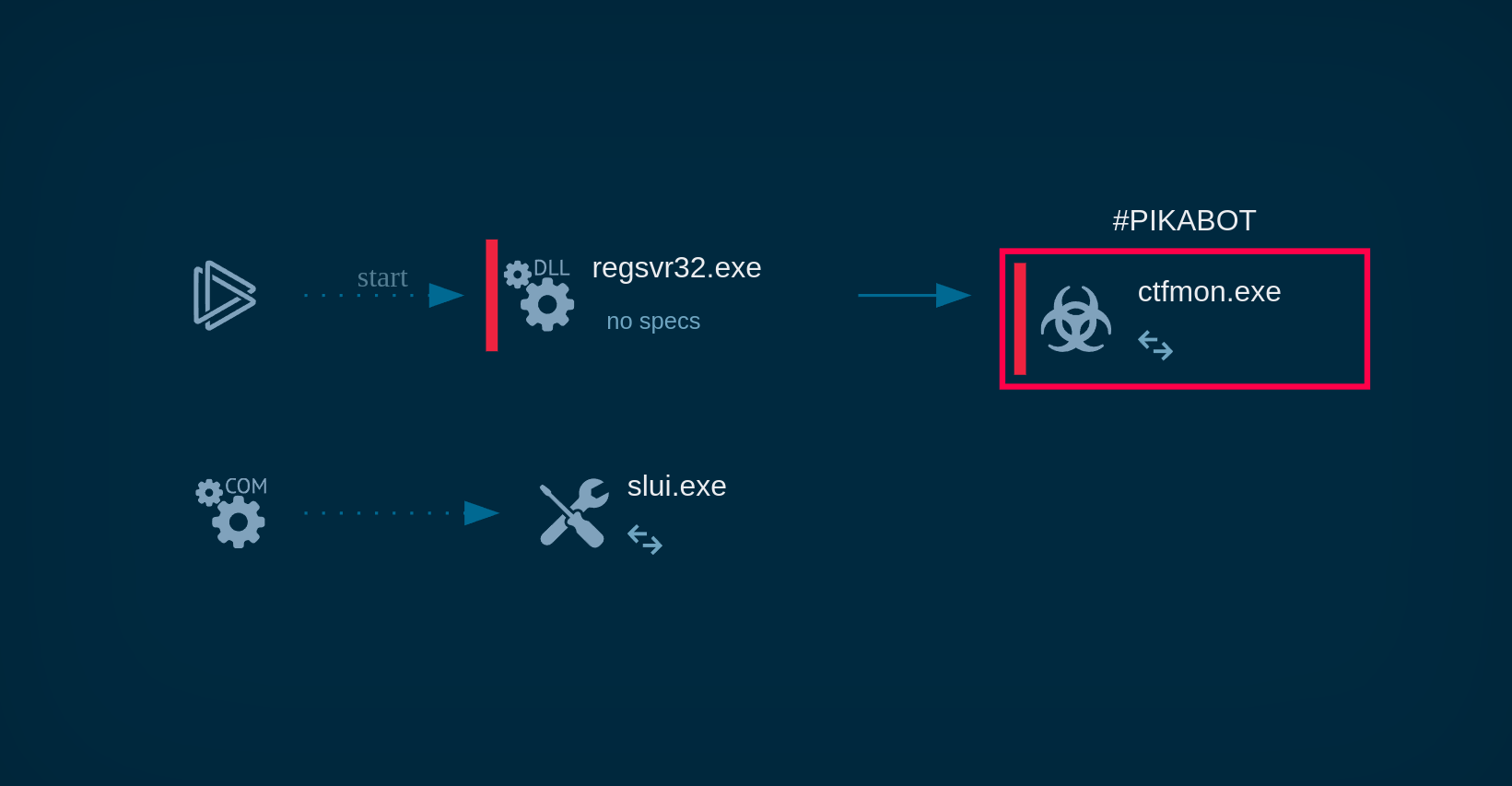 PikabotPikabot is a trojan malware with a focus on loader capabilities. Pikabot is also used for other activities, such as executing commands on the infected system. The earlier versions of the malware made use of extensive code obfuscation to evade detection. Upon infection, it collects system information and sends it to command-and-control servers.
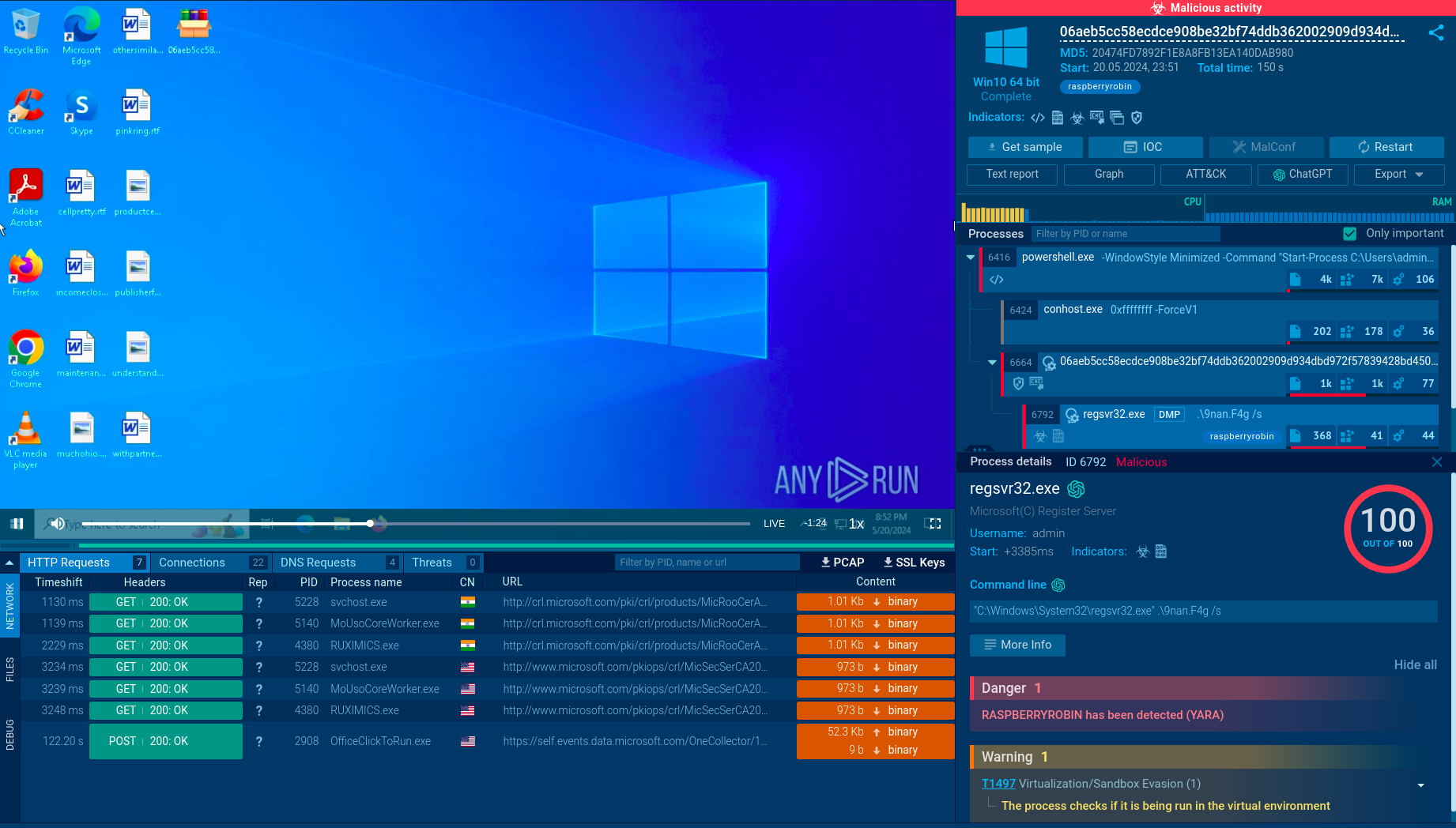 Raspberry RobinRaspberry Robin is a trojan that primarily spreads through infected USB drives and exploits legitimate Windows commands. This malware is known for its advanced obfuscation techniques, anti-debugging mechanisms, and ability to gain persistence on infected systems. Raspberry Robin often communicates with command-and-control servers over the TOR network and can download additional malicious payloads.